Pages

Tuesday, February 15, 2011

Comet Hunter's First Images on the Ground

Mission controllers at NASA's Jet Propulsion Laboratory, Pasadena, Calif., have begun receiving the first of 72 anticipated images of comet Tempel 1 taken by NASA's Stardust spacecraft.

The first six, most distant approach images are available at http://www.nasa.gov/stardust and http://www.jpl.nasa.gov. Additional images, including those from closest approach, are being downlinked in chronological order and will be available later in the day.

A news conference will be held at 12:30 p.m. PST (3:30 p.m. EST) to allow scientists more time to analyze the data and images.

Stardust-NExT is a low-cost mission that expands on the investigation of comet Tempel 1 initiated by NASA's Deep Impact spacecraft. JPL, a division of the California Institute of Technology in Pasadena, manages Stardust-NExT for NASA's Science Mission Directorate, Washington, D.C. Joe Veverka of Cornell University, Ithaca, N.Y., is the mission's principal investigator. Lockheed Martin Space Systems, Denver, built the spacecraft and manages day-to-day mission operations.

Monday, February 14, 2011

NASA Spacecraft Hours From Comet Encounter


As of today, Feb. 14, at 9:21 a.m. PST (12:21 p.m. EST), NASA's Stardust-NExT mission spacecraft is within a quarter-million miles (402,336 kilometers) of its quarry, comet Tempel 1, which it will fly by tonight. The spacecraft is cutting the distance with the comet at a rate of about 10.9 kilometers per second (6.77 miles per second or 24,000 mph).

The flyby of Tempel 1 will give scientists an opportunity to look for changes on the comet's surface since it was visited by NASA's Deep Impact spacecraft in July 2005. Since then, Tempel 1 has completed one orbit of the sun, and scientists are looking forward to discovering any differences in the comet.

The closest approach is expected tonight at approximately 8:40 p.m. PST (11:40 p.m. EST).

During the encounter phase, the spacecraft will carry out many important milestones in short order and automatically, as the spacecraft is too far away to receive timely updates from Earth. These milestones include turning the spacecraft to point its protective shields between it and the anticipated direction from which cometary particles would approach. Another milestone will occur at about four minutes to closest approach, when the spacecraft will begin science imaging of the comet's nucleus.


Sunday, February 13, 2011

SDO Celebrates One Year Anniversary

On February 11, 2010, at 10:23 in the morning, NASA's Solar Dynamics Observatory (SDO) launched into space on an Atlas rocket from Cape Canaveral. A year later, SDO has sent back millions of stunning images of the sun and a host of new data to help us understand the complex star at the heart of our solar system.

"One of the highlights of the last year is just that everything worked so smoothly," says astrophysicist Dean Pesnell, the project scientist for SDO at NASA's Goddard Space Flight Center in Greenbelt, Md. "We turned it on in March and it immediately started sending us data at 150 megabits per second. It worked from the very get go."


Thursday, February 10, 2011

New View of Family Life in the North American Nebula


Stars at all stages of development, from dusty little tots to young adults, are on display in a new image from NASA's Spitzer Space Telescope.

This cosmic community is called the North American nebula. In visible light, the region resembles the North American continent, with the most striking resemblance being the Gulf of Mexico. But in Spitzer's infrared view, the continent disappears. Instead, a swirling landscape of dust and young stars comes into view.

"One of the things that makes me so excited about this image is how different it is from the visible image, and how much more we can see in the infrared than in the visible," said Luisa Rebull of NASA's Spitzer Science Center at the California Institute of Technology, Pasadena, Calif. Rebull is lead author of a paper about the observations, accepted for publication in the Astrophysical Journal Supplement Series. "The Spitzer image reveals a wealth of detail about the dust and the young stars here."


Heading Into the Bonus Round – in Space

NASA's Stardust spacecraft was launched on Feb. 7, 1999, on a mission that would explore a comet as no previous mission had. Before Stardust, seven spacecraft from NASA, Russia, Japan and the European Space Agency had visited comets – they had flight profiles that allowed them to perform brief encounters, collecting data and sometimes images of the nuclei during the flyby.

Like those comet hunters before it, Stardust was tasked to pass closely by a comet, collecting data and snapping images. It also had the ability to come home again, carrying with it an out-of -this-world gift for cometary scientists – particles of the comet itself. Along the way, the telephone booth-sized comet hunter racked up numerous milestones and more than a few "space firsts."

Tuesday, February 08, 2011

NASA Hosting Events for Valentine's Night Comet Encounter

NASA will host several live activities for the Stardust-NExT mission's close encounter with comet Tempel 1. The closest approach is expected at approximately 8:37 p.m. PST (11:37 p.m. EST) on Feb. 14, with confirmation received on Earth at about 8:56 p.m. PST (11:56 p.m. EST).

Live coverage of the Tempel 1 encounter will begin at 8:30 p.m. PST on Feb. 14 on NASA Television and the agency's website. The coverage will include live commentary from mission control at NASA's Jet Propulsion Laboratory in Pasadena, Calif., and video from Lockheed Martin Space System's mission support area in Denver.

LRO Could Have Given Apollo 14 Crew Another Majestic View

Although the Apollo 14 mission to the moon was filled with incredible sights and was completely successful it met all its science goals the crew experienced a bit of a disappointment at missing the spectacular view from the rim of a 1,000-foot-wide crater. They might have gazed into its depths if they had the high-resolution maps now available from NASA's Lunar Reconnaissance Orbiter (LRO) spacecraft.

Pressure was on the Apollo 14 mission, launched January 31, 1971, from the start. The Apollo 13 landing had to be aborted because an oxygen tank explosion crippled the spacecraft as it was on its way to the moon. It was a heroic effort just to return the crew safely to Earth, but the Apollo 14 team knew a second failure would probably result in cancellation of the remaining Apollo missions.


Sunday, February 06, 2011

First Ever STEREO Images of the Entire Sun

On Feb. 6th, NASA's twin STEREO probes moved into position on opposite sides of the sun, and they are now beaming back uninterrupted images of the entire star—front and back.

"For the first time ever, we can watch solar activity in its full 3-dimensional glory," says Angelos Vourlidas, a member of the STEREO science team at the Naval Research Lab in Washington, DC.

"This is a big moment in solar physics," says Vourlidas. "STEREO has revealed the sun as it really is--a sphere of hot plasma and intricately woven magnetic fields."

Each STEREO probe photographs half of the star and beams the images to Earth. Researchers combine the two views to create a sphere. These aren't just regular pictures, however. STEREO's telescopes are tuned to four wavelengths of extreme ultraviolet radiation selected to trace key aspects of solar activity such as flares, tsunamis and magnetic filaments. Nothing escapes their attention.

Thursday, February 03, 2011

Surprise Hidden in Titan's Smog: Cirrus-Like Clouds


Every day is a bad-air day on Saturn's largest moon, Titan. Blanketed by haze far worse than any smog belched out in Los Angeles, Beijing or even Sherlock Holmes's London, the moon looks like a dirty orange ball. Described once as crude oil without the sulfur, the haze is made of tiny droplets of hydrocarbons with other, more noxious chemicals mixed in. Gunk.

Icky as it may sound, Titan is really the rarest of gems: the only moon in our solar system with an atmosphere worthy of a planet. This atmosphere comes complete with lightning, drizzle and occasionally a big, summer-downpour style of cloud made of methane or ethane -- hydrocarbons that are best known for their role in natural gas.

Now, thin, wispy clouds of ice particles, similar to Earth's cirrus clouds, are being reported by Carrie Anderson and Robert Samuelson at NASA's Goddard Space Flight Center in Greenbelt, Md. The findings, published February 1 in Icarus, were made using the Composite Infrared Spectrometer (CIRS) on NASA's Cassini spacecraft.

Wednesday, February 02, 2011

NASA's Kepler Spacecraft Discovers Extraordinary New Planetary System

Scientists using NASA's Kepler, a space telescope, recently discovered six planets made of a mix of rock and gases orbiting a single sun-like star, known as Kepler-11, which is located approximately 2,000 light years from Earth.

"The Kepler-11 planetary system is amazing," said Jack Lissauer, a planetary scientist and a Kepler science team member at NASA's Ames Research Center, Moffett Field, Calif. "It’s amazingly compact, it’s amazingly flat, there’s an amazingly large number of big planets orbiting close to their star - we didn’t know such systems could even exist."

In other words, Kepler-11 has the fullest, most compact planetary system yet discovered beyond our own.

"Few stars are known to have more than one transiting planet, and Kepler-11 is the first known star to have more than three," said Lissauer. "So we know that systems like this are not common. There’s certainly far fewer than one percent of stars that have systems like Kepler-11. But whether it’s one in a thousand, one in ten thousand or one in a million, that we don’t know, because we only have observed one of them."

Cassini Sends Back Postcards of Saturn Moons


On Jan. 31, 2011, NASA's Cassini spacecraft passed by several of Saturn's intriguing moons, snapping images along the way. Cassini passed within about 60,000 kilometers (37,282 miles) of Enceladus and 28,000 kilometers (17,398 miles) of Helene. It also caught a glimpse of Mimas in front of Saturn's rings. In one of the images, Cassini is looking at the famous jets erupting from the south polar terrain of Enceladus.

The Cassini-Huygens mission is a cooperative project of NASA, the European Space Agency and the Italian Space Agency. The Jet Propulsion Laboratory, a division of the California Institute of Technology in Pasadena, manages the Cassini-Huygens mission for NASA's Science Mission Directorate, Washington. The Cassini orbiter and its two onboard cameras were designed, developed and assembled at JPL. The imaging team is based at the Space Science Institute in Boulder, Colo.

Tuesday, February 01, 2011

Tracking the Origins of Speedy Space Particles

NASA's Time History of Events and Macroscale Interaction during Substorms (THEMIS) spacecraft combined with computer models have helped track the origin of the energetic particles in Earth's magnetic atmosphere that appear during a kind of space weather called a substorm. Understanding the source of such particles and how they are shuttled through Earth's atmosphere is crucial to better understanding the Sun's complex space weather system and thus protect satellites or even humans in space.

The results show that these speedy electrons gain extra energy from changing magnetic fields far from the origin of the substorm that causes them. THEMIS, which consists of five orbiting satellites, helped provide these insights when three of the spacecraft traveled through a large substorm on February 15, 2008. This allowed scientists to track changes in particle energy over a large distance. The observations were consistent with numerical models showing an increase in energy due to changing magnetic fields, a process known as betatron acceleration.

"The origin of fast electrons in substorms has been a puzzle," says Maha Ashour-Abdalla, the lead author of a Nature Physics paper that appeared online on January 30, 2011 on the subject and a physicist at the University of California, Los Angeles. "It hasn't been clear until now if they got their burst of speed in the middle of the storm, or from some place further away."


Thursday, January 27, 2011

Asteroids Ahoy! Jupiter Scar Likely from Rocky Body


A hurtling asteroid about the size of the Titanic caused the scar that appeared in Jupiter's atmosphere on July 19, 2009, according to two papers published recently in the journal Icarus.

Data from three infrared telescopes enabled scientists to observe the warm atmospheric temperatures and unique chemical conditions associated with the impact debris. By piecing together signatures of the gases and dark debris produced by the impact shockwaves, an international team of scientists was able to deduce that the object was more likely a rocky asteroid than an icy comet. Among the teams were those led by Glenn Orton, an astronomer at NASA's Jet Propulsion Laboratory, Pasadena, Calif., and Leigh Fletcher, researcher at Oxford University, U.K., who started the work while he was a postdoctoral fellow at JPL.

"Both the fact that the impact itself happened at all and the implication that it may well have been an asteroid rather than a comet shows us that the outer solar system is a complex, violent and dynamic place, and that many surprises may be out there waiting for us," said Orton. "There is still a lot to sort out in the outer solar system."


NASA's Hubble Finds Most Distant Galaxy Candidate Ever Seen in Universe

Astronomers have pushed NASA's Hubble Space Telescope to its limits by finding what is likely to be the most distant object ever seen in the universe. The object's light traveled 13.2 billion years to reach Hubble, roughly 150 million years longer than the previous record holder. The age of the universe is approximately 13.7 billion years.

The tiny, dim object is a compact galaxy of blue stars that existed 480 million years after the big bang. More than 100 such mini-galaxies would be needed to make up our Milky Way. The new research offers surprising evidence that the rate of star birth in the early universe grew dramatically, increasing by about a factor of 10 from 480 million years to 650 million years after the big bang.

Tuesday, January 25, 2011

Runaway Star Plows Through Space


A massive star flung away from its former companion is plowing through space dust. The result is a brilliant bow shock, seen here as a yellow arc in a new image from NASA's Wide-field Infrared Survey Explorer, or WISE.

The star, named Zeta Ophiuchi, is huge, with a mass of about 20 times that of our sun. In this image, in which infrared light has been translated into visible colors we see with our eyes, the star appears as the blue dot inside the bow shock.

Zeta Ophiuchi once orbited around an even heftier star. But when that star exploded in a supernova, Zeta Ophiuchi shot away like a bullet. It's traveling at a whopping 54,000 miles per hour (or 24 kilometers per second), and heading toward the upper left area of the picture.


Friday, January 21, 2011

Voyager Celebrates 25 Years Since Uranus Visit


As NASA's Voyager 2 spacecraft made the only close approach to date of our mysterious seventh planet Uranus 25 years ago, Project Scientist Ed Stone and the Voyager team gathered at NASA's Jet Propulsion Laboratory, Pasadena, Calif., to pore over the data coming in.

Images of the small, icy Uranus moon Miranda were particularly surprising. Since small moons tend to cool and freeze over rapidly after their formation, scientists had expected a boring, ancient surface, pockmarked by crater-upon-weathered-crater. Instead they saw grooved terrain with linear valleys and ridges cutting through the older terrain and sometimes coming together in chevron shapes. They also saw dramatic fault scarps, or cliffs. All of this indicated that periods of tectonic and thermal activity had rocked Miranda's surface in the past.

The scientists were also shocked by data showing that Uranus's magnetic north and south poles were not closely aligned with the north-south axis of the planet's rotation. Instead, the planet's magnetic field poles were closer to the Uranian equator. This suggested that the material flows in the planet's interior that are generating the magnetic field are closer to the surface of Uranus than the flows inside Earth, Jupiter and Saturn are to their respective surfaces.


NASA’s Glory Mission Will Study Key Pieces of the Climate Puzzle

Earth’s climate continues to change at a rapid pace.

Last week, NASA announced that 2010 was tied as the warmest year on record. Likewise, the last decade was the warmest in the 130-year global temperature record maintained by scientists at NASA’s Goddard Institute for Space Studies (GISS) in New York City.

Meanwhile, at Vandenberg Air Force Base in California, engineers are preparing NASA’s next Earth-observing mission -- a satellite called Glory -- for launch in late February. The satellite, which contains two instruments that will monitor key parts of the climate system, aims to offer a new stream of data that climatologists will use as part of an ongoing effort to improve the accuracy of climate models.

Thursday, January 20, 2011

NASA Spacecraft Prepares for Valentine's Day Comet Rendezvous


NASA's Stardust-NExT spacecraft is nearing a celestial date with comet Tempel 1 at approximately 8:37 p.m. PST (11:37 p.m. EST), on Feb. 14. The mission will allow scientists for the first time to look for changes on a comet's surface that occurred following an orbit around the sun.

The Stardust-NExT, or New Exploration of Tempel, spacecraft will take high-resolution images during the encounter, and attempt to measure the composition, distribution, and flux of dust emitted into the coma, or material surrounding the comet's nucleus. Data from the mission will provide important new information on how Jupiter-family comets evolved and formed.

The mission will expand the investigation of the comet initiated by NASA's Deep Impact mission. In July 2005, the Deep Impact spacecraft delivered an impactor to the surface of Tempel 1 to study its composition. The Stardust spacecraft may capture an image of the crater created by the impactor. This would be an added bonus to the huge amount of data that mission scientists expect to obtain.


Wednesday, January 19, 2011

Cosmonauts to Perform 27th Russian Space Station Spacewalk


Two Russian cosmonauts will venture outside the International Space Station on Jan. 21 to complete installation of a new high-speed data transmission system, remove an old plasma pulse experiment, install a camera for the new Rassvet docking module and retrieve a materials exposure package.

Expedition 26 Flight Engineers Dmitry Kondratyev and Oleg Skripochka are scheduled to float outside the Pirs airlock at 9:20 a.m. EST to begin the six-hour excursion. Both spacewalkers will wear Russian Orlan-MK spacesuits.

Kondratyev will be designated as Extravehicular 1 (EV1), with a red stripe on his suit, and Skripochka will be EV2, with a blue stripe on his suit. Skripochka also will wear a NASA-provided wireless television camera system and helmet lights to provide live point-of-view video to Mission Control-Moscow, which will provide ground support for the spacewalk. Mission Control-Houston will monitor the spacewalk as well.

Wednesday, January 12, 2011

NASA's Hubble Finds that Puny Stars Pack a Big Punch

A deep survey of more than 200,000 stars in our Milky Way galaxy has unveiled the sometimes petulant behavior of tiny red dwarf stars. These stars, which are smaller than the Sun, can unleash powerful eruptions called flares that may release the energy of more than 100 million atomic bombs.

Red dwarfs are the most abundant stars in our universe and are presumably hosts to numerous planets. However, their erratic behavior could make life unpleasant, if not impossible, for many alien worlds. Flares are sudden eruptions of heated plasma that occur when powerful magnetic field lines in a star's atmosphere "reconnect," snapping like a rubber band and releasing vast amounts of energy. When they occur, flares would blast any planets orbiting the star with ultraviolet light, bursts of X-rays, and a gush of charged particles called a stellar wind.

Studying the light from 215,000 red dwarfs collected in observations by NASA's Hubble Space Telescope, astronomers found 100 stellar flares. The observations, taken over a seven-day period, constitute the largest continuous monitoring of red dwarf stars ever undertaken.

Tuesday, January 11, 2011

NASA'S Kepler Mission Discovers Its First Rocky Planet

NASA's Kepler mission confirmed the discovery of its first rocky planet, named Kepler-10b. Measuring 1.4 times the size of Earth, it is the smallest planet ever discovered outside our solar system.

The discovery of this so-called exoplanet is based on more than eight months of data collected by the spacecraft from May 2009 to early January 2010.

"All of Kepler's best capabilities have converged to yield the first solid evidence of a rocky planet orbiting a star other than our sun," said Natalie Batalha, Kepler's deputy science team lead at NASA's Ames Research Center in Moffett Field, Calif., and primary author of a paper on the discovery accepted by the Astrophysical Journal. "The Kepler team made a commitment in 2010 about finding the telltale signatures of small planets in the data, and it's beginning to pay off."

Kepler's ultra-precise photometer measures the tiny decrease in a star's brightness that occurs when a planet crosses in front of it. The size of the planet can be derived from these periodic dips in brightness. The distance between the planet and the star is calculated by measuring the time between successive dips as the planet orbits the star.


Saturday, January 08, 2011

NASA Chat: The Quest for Planets


A new planet discovery will be announced Monday Jan. 10 during the 'Exoplanets & Their Host Stars' presentation at the American Astronomical Society (AAS) conference in Seattle, Washington.

Kepler is NASA's first mission to look specifically for Earth-size planets in the habitable zones (areas where liquid water could exist) around stars like our sun. Kepler will spend 3-1/2 years surveying more than 100,000 stars in the Cygnus-Lyra region of our Milky Way galaxy. More than 300 exoplanets have been discovered previously, most of which are low-density gas giants such as Jupiter or Saturn in our own solar system.

Natalie Batalha of the NASA Kepler Mission Team will be online answering your questions about this new planet finding on Monday, Jan. 10 from 3:30 p.m. to 4:30 p.m. EST / 12:30 p.m. to 1:30 p.m. PST. Natalie will be chatting with you live from the conference in Seattle.

Joining the chat is easy. Simply visit this page on Monday from 3:30 p.m. to 4:30 p.m. EST / 12:30 p.m. to 1:30 p.m. PST. The chat window will open at the bottom of this page starting 15 minutes before the chat. You can log in and be ready to ask questions at 3:30 p.m.

Friday, January 07, 2011

Hinode Observes Annular Solar Eclipse


On January 4, the Hinode satellite captured these breathtaking images of an annular solar eclipse. An annular eclipse occurs when the moon, slightly more distant from Earth than on average, moves directly between Earth and the sun, thus appearing slightly smaller to observers' eyes; the effect is a bright ring, or annulus of sunlight, around the silhouette of the moon. Hinode, a Japanese mission in partnership with NASA, NAOJ, STFC, ESA, and NSC, currently in Earth orbit, is studying the Sun to improve our understanding of the mechanisms that power the solar atmosphere and drive solar eruptions.

Thursday, January 06, 2011

Andromeda is So Hot 'n' Cold


This mosaic of the Andromeda spiral galaxy highlights explosive stars in its interior, and cooler, dusty stars forming in its many rings. The image is a combination of observations from the Herschel Space Observatory taken in infrared light (seen in orange hues), and the XMM-Newton telescope captured in X-rays (seen in blues). NASA plays a role in both of these European Space Agency-led missions.

Herschel provides a detailed look at the cool clouds of star birth that line the galaxy's five concentric rings. Massive young stars are heating blankets of dust that surround them, causing them to glow in the longer-wavelength infrared light, known as far-infrared, that Herschel sees.

In contrast, XMM-Newton is capturing what happens at the end of the lives of massive stars. It shows the high-energy X-rays that come from, among other objects, supernova explosions and massive dead stars rotating around companions. These X-ray sources are clustered in the center of the galaxy, where the most massive stars tend to form.

Andromeda is our Milky Way galaxy's nearest large neighbor. It is located about 2.5 million light-years away and holds up to an estimated trillion stars. Our Milky Way is thought to contain about 200 billion to 400 billion stars.


Wednesday, January 05, 2011

Rover Will Spend 7th Birthday at Stadium-Size Crater


The High Resolution Imaging Science Experiment (HiRISE) camera on NASA's Mars Reconnaissance Orbiter captured a Dec. 31, 2010, view of the Mars Exploration Rover Opportunity on the southwestern rim of a football-field-size crater called "Santa Maria."

Opportunity arrived at the western edge of Santa Maria crater in mid-December and will spend about two months investigating rocks there. That investigation will take Opportunity into the beginning of its eighth year on Mars. Opportunity landed in the Meridiani Planum region of Mars on Jan. 25, 2004, Universal Time (Jan. 24, Pacific Time) for a mission originally planned to last for three months.

Tuesday, January 04, 2011

Bob Benson: Tales of Chilly Research

As the weather gets colder in Maryland, Bob Benson tells tales of winters he used to know in Minnesota, the South Pole, and Alaska. A five-decade career studying Earth's ionosphere – the part of Earth's atmosphere that reflects radio communication waves – has taken him to some extreme latitudes.

Standing in the corner of Bob Benson's office is a microfilm reader. You know, the big, boxy machine that was used to look up archived newspaper articles before such things were an Internet search away. That machine is one of the tools Benson has used to scan decades worth of data throughout his 46 years at NASA’s Goddard Space Flight Center in Greenbelt, Md. He studies the ionosphere – the swath of our atmosphere filled with electrons and ions stretching from about 30 to 600 miles above Earth's surface – and the data he studied from various ionospheric satellites were displayed on 35-millimeter film.

"We had thousands of these boxes," he says, holding up a small cardboard box in which a film lies curled. "When I first came here, we'd go pull them from a drawer at the National Space Science Data Center at Goddard and do analysis with a machine like this."


Monday, January 03, 2011

Discovery External Tank Repairs Begin Monday as Engineers Analyze Data

Technicians working on space shuttle Discovery's external fuel tank in the Vehicle Assembly Building at NASA's Kennedy Space Center in Florida are off for the New Year holiday weekend. On Monday, they'll begin repairs on three support beams, called stringers, that recently were detected to have small cracks on their tops.

Engineers at various NASA centers continue to analyze data from testing and X-ray type image scans collected during the past week of all 108 stringers on the outside of the external tank's ‪intertank section. The image scans showed four small cracks on three stringers on the opposite side of the tank from Discovery. Managers decided Thursday to have those cracks repaired in a similar fashion to repairs made on cracks on two stringers found after Discovery's Nov. 5 launch attempt.

The repair work is estimated to take 2–3 days. Any further work will be evaluated thoroughly during the week after additional data and analysis are reviewed.

Managers also continue to evaluate an option to perform known and practiced modifications on some stringers. Before breaking for the holiday, technicians reconfigured scaffolding to provide access for the modification work, should it be required. A decision may be made on that work as early as Monday.


View this site boat building, boat builders, wood preservative, construction marine, marine contractors

Friday, December 31, 2010

Free NASA Apps for iPhone, iPad Available


The NASA App for iPhone, iPod touch and iPad, combines all of your favorite NASA images, videos, missions and information into one, easy-to-use, application. It's available free of charge on the App Store from Apple directly on iPhone, iPod touch and iPad or within iTunes.


Thursday, December 30, 2010

Cassini Celebrates 10 Years Since Jupiter Encounter


Ten years ago, on Dec. 30, 2000, NASA's Cassini spacecraft made its closest approach to Jupiter on its way to orbiting Saturn. The main purpose was to use the gravity of the largest planet in our solar system to slingshot Cassini towards Saturn, its ultimate destination. But the encounter with Jupiter, Saturn's gas-giant big brother, also gave the Cassini project a perfect lab for testing its instruments and evaluating its operations plans for its tour of the ringed planet, which began in 2004.

"The Jupiter flyby allowed the Cassini spacecraft to stretch its wings, rehearsing for its prime time show, orbiting Saturn," said Linda Spilker, Cassini project scientist based at NASA's Jet Propulsion Laboratory in Pasadena, Calif. "Ten years later, findings from the Jupiter flyby still continue to shape our understanding of similar processes in the Saturn system."

Cassini spent about six months - from October 2000 to March 2001 - exploring the Jupiter system. The closest approach brought Cassini to within about 9.7 million kilometers (6 million miles) of Jupiter's cloud tops at 2:05 a.m. Pacific Time, or 10:05 a.m. UTC, on Dec. 30, 2000.


Wednesday, December 29, 2010

SOHO Spots 2000th Comet

As people on Earth celebrate the holidays and prepare to ring in the New Year, an ESA/NASA spacecraft has quietly reached its own milestone: on December 26, the Solar and Heliospheric Observatory (SOHO) discovered its 2000th comet.

Drawing on help from citizen scientists around the world, SOHO has become the single greatest comet finder of all time. This is all the more impressive since SOHO was not specifically designed to find comets, but to monitor the sun.

"Since it launched on December 2, 1995 to observe the sun, SOHO has more than doubled the number of comets for which orbits have been determined over the last three hundred years," says Joe Gurman, the U.S. project scientist for SOHO at NASA's Goddard Space Flight Center in Greenbelt, Md.

Tuesday, December 28, 2010

NASA's AMAZING YEAR OF EXPLORATION


NASA in 2010 set a new course for human spaceflight, helped rewrite science textbooks, redefined our understanding of Earth’s nearest celestial neighbor, put the finishing touches on one of the world's greatest engineering marvels, made major contributions to life on Earth, and turned its sights toward the next era of exploration.

"This year, NASA’s work made headlines around the world, " NASA Administrator Charles Bolden said. "More importantly, it enlarged our understanding of the universe and our home planet, inspired people, and opened new frontiers for our dreams and aspirations."

"NASA achievements this year across the spectrum -- from science, to aeronautics, education and human spaceflight - provided incredible value to our nation, "NASA Deputy Administrator Lori Garver said. "We continue to build upon our rich history, taking on new challenges and doing the things that no one else can do -- all for the benefit of humanity."


Monday, December 27, 2010

Opportunity Studying a Football-Field Size Crater

NASA's Mars Exploration Rover Opportunity reached a crater about the size of a football field—some 90 meters (295 feet) in diameter. The rover team plans to use cameras and spectrometers during the next several weeks to examine rocks exposed at the crater, informally named "Santa Maria."

A mosaic of image frames taken by Opportunity's navigation camera on Dec. 16 shows the crater's sharp rim and rocks ejected from the impact that had excavated the crater.

Opportunity completed its three-month prime mission on Mars in April 2004 and has been working in bonus extended missions since then. After the investigations at Santa Maria, the rover team plans to resume a long-term trek by Opportunity to the rim of Endeavour Crater, which is about 22 kilometers (14 miles) in diameter.


Wednesday, December 22, 2010

Cassini Marks Holidays With Dramatic Views of Rhea


Newly released for the holidays, images of Saturn's second largest moon Rhea obtained by NASA's Cassini spacecraft show dramatic views of fractures cutting through craters on the moon's surface, revealing a history of tectonic rumbling. The images are among the highest-resolution views ever obtained of Rhea.

The images, captured on flybys on Nov. 21, 2009 and March 2, 2010, can be found at http://www.nasa.gov/cassini, http://saturn.jpl.nasa.gov and http://ciclops.org .

"These recent, high-resolution Cassini images help us put Saturn's moon in the context of the moons' geological family tree," said Paul Helfenstein, Cassini imaging team associate, based at Cornell University, Ithaca, N.Y. "Since NASA's Voyager mission visited Saturn, scientists have thought of Rhea and Dione as close cousins, with some differences in size and density. The new images show us they're more like fraternal twins, where the resemblance is more than skin deep. This probably comes from their nearness to each other in orbit."

Tuesday, December 21, 2010

Supermassive Black Holes


This two-panel graphic contains two composite images of galaxies used in a recent study of supermassive black holes. In each of the galaxies, data from NASA's Chandra X-ray Observatory are blue, and optical data from the Sloan Digital Sky survey are colored red, green and blue. The galaxy on the left, Abell 644, is in the center of a galaxy cluster that lies about 1.1 billion light years from Earth. On the right is an isolated, or "field," galaxy named SDSS J1021+131, which is located about 900 million light years away. At the center of both of these galaxies is a growing supermassive black hole, called an active galactic nucleus (AGN) by astronomers, which is pulling in large quantities of gas.

A newly published study from Chandra tells scientists how often the biggest black holes in field galaxies like SDSS J1021+131 have been active over the last few billion years. This has important implications for how environment affects black hole growth. The scientists found that only about one percent of field galaxies with masses similar to the Milky Way contain supermassive black holes in their most active phase. They also found that the most massive galaxies are the most likely to host these AGN, and that there is a gradual decline in the AGN fraction with cosmic time. Finally, the AGN fraction for field galaxies was found to be indistinguishable from that for galaxies in dense clusters, like Abell 644.

Thursday, December 16, 2010

Contempo technologies PVT LTD

Life is best at Contempo technologies PVT LTD. I joined Contempo SEG before a year. I have been in more than 4 companies and this is the first time I am experiencing homely atmosphere. People are very friendly and Contempo technologies organizes many social events that helps to know each other. All other companies I worked rarely care about employee socialism. In Contempo tech that is not the case people are allowed to be friendly with each other in a pleasant office environment. Events like Christmas party, quiz, Halloween party makes people enjoy the company. Contempo technologies pvt ltd has a team that helps people get to know each other. At Contempo I never felt I am at an IT company. Usually IT work is very stressful but in this company it has not been the case. Don’t think I am writing a positive review about the company I work but it is true that this company made the difference while other companies did not.

Please name one company that gives equal important to extra curricular activities and work. Here in Contempo technologies PVT ltd they do it they give us the feeling that we need to be part of this world to work and enjoy. People here are not just money minded most companies are just money minded and never care what people think about the work environment. Other companies I worked they just want us to work and leave the place in many cases I worked till late nights but they never encouraged me financially. All they want is work , work , work from me. But in Contempo technologies pvt ltd they don’t see it that way. The way they give important to fun activities it clearly portraits their feeling on what they want to give to an employee. Contempo technologies PVT LTd just don’t see work they utilize our other special skills too. I was personally afraid of going on stage this has changed now and I can boldly face people because of Contempo SEG. I sincerely hope this company grows into one of the leading MNCs.

Monday, December 13, 2010

Space Shuttle Mission: STS-133

The call to stations at NASA's Kennedy Space Center is expected to begin this afternoon as the launch team takes its place for a tanking test scheduled to begin no earlier than Wednesday, Dec. 15. Technicians at Launch Pad 39A also are preparing space shuttle Discovery for the test which calls for dozens of instruments to be placed on the ribbed intertank region of Discovery's external tank.

Saturday, December 11, 2010

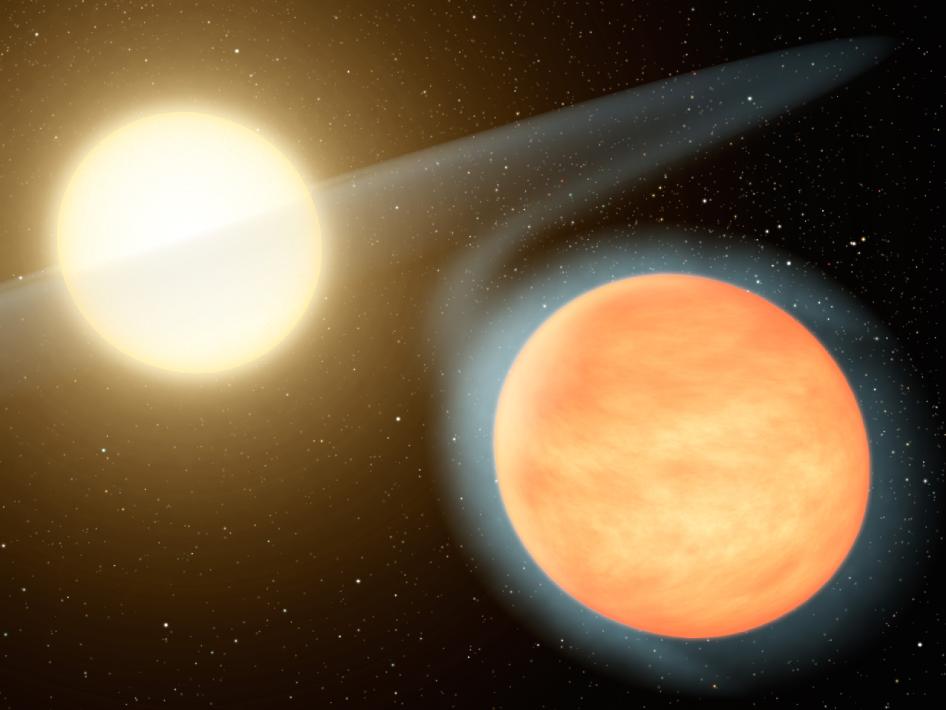
NASA's Spitzer Reveals First Carbon-Rich Planet

Astronomers have discovered that a huge, searing-hot planet orbiting another star is loaded with an unusual amount of carbon. The planet, a gas giant named WASP-12b, is the first carbon-rich world ever observed. The discovery was made using NASA's Spitzer Space Telescope, along with previously published ground-based observations.

"This planet reveals the astounding diversity of worlds out there," said Nikku Madhusudhan of the Massachusetts Institute of Technology, Cambridge, lead author of a report in the Dec. 9 issue of the journal Nature. "Carbon-rich planets would be exotic in every way -- formation, interiors and atmospheres."

It's possible that WASP-12b might harbor graphite, diamond, or even a more exotic form of carbon in its interior, beneath its gaseous layers. Astronomers don't currently have the technology to observe the cores of exoplanets, or planets orbiting stars beyond our sun, but their theories hint at these intriguing possibilities.


Wednesday, December 08, 2010

SpaceX Falcon 9

The first SpaceX Falcon 9 demonstration launch for NASA's Commercial Orbital Transportation Services program is scheduled for Wednesday, Dec. 8, from Launch Complex 40 at Cape Canaveral Air Force Station in Florida. The launch window extends from 9 a.m. to 12:22 p.m. EST.

Monday, December 06, 2010

NASA Aids in Characterizing Super-Earth


A team of astronomers, including two NASA Sagan Fellows, has made the first characterizations of a super-Earth's atmosphere, by using a ground-based telescope. A super-Earth is a planet up to three times the size of Earth and weighing up to 10 times as much. The findings, reported in the Dec. 2 issue of the journal Nature, are a significant milestone toward eventually being able to probe the atmospheres of Earth-like planets for signs of life.

The team determined the planet, GJ 1214b, is either blanketed with a thin layer of water steam or surrounded by a thick layer of high clouds. If the former, the planet itself would have an icy composition. If the latter, the planet would be rocky or similar to the composition of Neptune, though much smaller.

"This is the first super-Earth known to have an atmosphere," said Jacob Bean, a NASA Sagan Fellow and astronomer at the Harvard-Smithsonian Center for Astrophysics in Cambridge, Mass. "But even with these new measurements, we can't say yet what that atmosphere is made of. This world is being very shy and veiling its true nature from us."

GJ 1214b, first discovered in December 2009, is 2.7 times the size of Earth and 6.5 times as massive. Previous observations of the planet's size and mass demonstrated it has a low density for its size, leading astronomers to conclude the planet is some kind of solid body with an atmosphere.

The planet orbits close to its dim star, at a distance of 0.014 astronomical units. An astronomical unit is the distance between Earth and the sun, approximately 93 million miles. GJ 1214b circles too close to its star to be habitable by any life forms.

Bean and his team observed infrared light as the planet crossed in front of its star. During such transits, the star's light filters through the atmosphere. Gases absorb the starlight at particular wavelengths, leaving behind chemical fingerprints detectable from Earth. This same type of technique has been used to study the atmospheres of distant "hot Jupiters," or Jupiter-like planets orbiting close to their stars, and found gases like hydrogen, methane and sodium vapor.

In the case of the super-Earth, no chemical fingerprints were detected; however, this doesn't mean there are no chemicals present. Instead, this information ruled out some possibilities for GJ 1214b's atmosphere, and narrowed the scope to either an atmosphere of water steam or high clouds. Astronomers believe it's more likely the atmosphere is too thin around the planet to let enough light filter through and reveal chemical fingerprints.

"A steamy atmosphere would have to be very dense – about one-fifth water vapor by volume -- compared to our Earth, with an atmosphere that's four-fifths nitrogen and one-fifth oxygen with only a touch of water vapor," Bean said. "During the next year, we should have some solid answers about what this planet is truly like."

The team, which included Bean's co-authors -- Eliza Miller-Ricci Kempton, a NASA Sagan Fellow at the University of California in Santa Cruz, and Derek Homeier of the Institute for Astrophysics in Gottingen, Germany -- examined GJ 1214b using the ground-based Very Large Telescope at Paranal Observatory in Chile.

"This is an important step forward, narrowing our understanding of the atmosphere of this planet," said NASA Exoplanet Exploration Program Scientist Douglas Hudgins at NASA Headquarters in Washington. "Bizarre worlds like this make exoplanet science one of the most compelling areas in astrophysics today."

The Sagan Fellowship Program is administered by the NASA Exoplanet Science Institute at the California Institute of Technology in Pasadena. Its purpose is to advance the scientific and technical goals of NASA's Exoplanet Exploration Program. The program is managed for NASA by the Jet Propulsion Laboratory in Pasadena, Calif. Caltech manages JPL for NASA.

More information about NASA's planet-finding missions is online at:http://planetquest.jpl.nasa.gov . More information about NASA's Sagan Fellowship Program is at http://nexsci.caltech.edu/sagan .

Saturday, December 04, 2010

Cassini Returns Images of Bright Jets at Enceladus


NASA's Cassini spacecraft successfully dipped near the surface of Saturn's moon Enceladus on Nov. 30. Though Cassini's closest approach took it to within about 48 kilometers (30 miles) of the moon's northern hemisphere, the spacecraft also captured shadowy images of the tortured south polar terrain and the brilliant jets that spray out from it.

Many of the raw images feature darkened terrain because winter has descended upon the southern hemisphere of Enceladus. But sunlight behind the moon backlights the jets of water vapor and icy particles. In some images, the jets line up in rows, forming curtains of spray.

The new raw images can be seen at http://saturn.jpl.nasa.gov/photos/raw/ .

The Enceladus flyby was the 12th of Cassini's mission, with the spacecraft swooping down around 61 degrees north latitude. This encounter and its twin three weeks later at the same altitude and latitude, are the closest Cassini will come to the northern hemisphere surface of Enceladus during the extended Solstice mission. (Cassini's closest-ever approach to Enceladus occurred in October 2008, when the spacecraft dipped to an altitude of 25 kilometers, or 16 miles.)

Among the observations Cassini made during this Enceladus flyby, the radio science subsystem collected gravity measurements to understand the moon's interior structure, and the fields and particles instruments sampled the charged particle environment around the moon.

About two days before the Enceladus flyby, Cassini also passed the sponge-like moon Hyperion, beaming back intriguing images of the craters on its surface. The flyby, at 72,000 kilometers (45,000 miles) in altitude, was one of the closest approaches to Hyperion that Cassini has made.

Scientists are still working to analyze the data and images collected during the flybys.

The Cassini-Huygens mission is a cooperative project of NASA, the European Space Agency and the Italian Space Agency. The Jet Propulsion Laboratory manages the project for NASA's Science Mission Directorate in Washington. The Cassini orbiter was designed, developed and assembled at JPL. The imaging operations center is based at the Space Science Institute in Boulder, Colo.

More Cassini information is available, at t http://www.nasa.gov/cassini and http://saturn.jpl.nasa.gov .