Pages

Thursday, January 20, 2011

NASA Spacecraft Prepares for Valentine's Day Comet Rendezvous


NASA's Stardust-NExT spacecraft is nearing a celestial date with comet Tempel 1 at approximately 8:37 p.m. PST (11:37 p.m. EST), on Feb. 14. The mission will allow scientists for the first time to look for changes on a comet's surface that occurred following an orbit around the sun.

The Stardust-NExT, or New Exploration of Tempel, spacecraft will take high-resolution images during the encounter, and attempt to measure the composition, distribution, and flux of dust emitted into the coma, or material surrounding the comet's nucleus. Data from the mission will provide important new information on how Jupiter-family comets evolved and formed.

The mission will expand the investigation of the comet initiated by NASA's Deep Impact mission. In July 2005, the Deep Impact spacecraft delivered an impactor to the surface of Tempel 1 to study its composition. The Stardust spacecraft may capture an image of the crater created by the impactor. This would be an added bonus to the huge amount of data that mission scientists expect to obtain.


Wednesday, January 19, 2011

Cosmonauts to Perform 27th Russian Space Station Spacewalk


Two Russian cosmonauts will venture outside the International Space Station on Jan. 21 to complete installation of a new high-speed data transmission system, remove an old plasma pulse experiment, install a camera for the new Rassvet docking module and retrieve a materials exposure package.

Expedition 26 Flight Engineers Dmitry Kondratyev and Oleg Skripochka are scheduled to float outside the Pirs airlock at 9:20 a.m. EST to begin the six-hour excursion. Both spacewalkers will wear Russian Orlan-MK spacesuits.

Kondratyev will be designated as Extravehicular 1 (EV1), with a red stripe on his suit, and Skripochka will be EV2, with a blue stripe on his suit. Skripochka also will wear a NASA-provided wireless television camera system and helmet lights to provide live point-of-view video to Mission Control-Moscow, which will provide ground support for the spacewalk. Mission Control-Houston will monitor the spacewalk as well.

Wednesday, January 12, 2011

NASA's Hubble Finds that Puny Stars Pack a Big Punch

A deep survey of more than 200,000 stars in our Milky Way galaxy has unveiled the sometimes petulant behavior of tiny red dwarf stars. These stars, which are smaller than the Sun, can unleash powerful eruptions called flares that may release the energy of more than 100 million atomic bombs.

Red dwarfs are the most abundant stars in our universe and are presumably hosts to numerous planets. However, their erratic behavior could make life unpleasant, if not impossible, for many alien worlds. Flares are sudden eruptions of heated plasma that occur when powerful magnetic field lines in a star's atmosphere "reconnect," snapping like a rubber band and releasing vast amounts of energy. When they occur, flares would blast any planets orbiting the star with ultraviolet light, bursts of X-rays, and a gush of charged particles called a stellar wind.

Studying the light from 215,000 red dwarfs collected in observations by NASA's Hubble Space Telescope, astronomers found 100 stellar flares. The observations, taken over a seven-day period, constitute the largest continuous monitoring of red dwarf stars ever undertaken.

Tuesday, January 11, 2011

NASA'S Kepler Mission Discovers Its First Rocky Planet

NASA's Kepler mission confirmed the discovery of its first rocky planet, named Kepler-10b. Measuring 1.4 times the size of Earth, it is the smallest planet ever discovered outside our solar system.

The discovery of this so-called exoplanet is based on more than eight months of data collected by the spacecraft from May 2009 to early January 2010.

"All of Kepler's best capabilities have converged to yield the first solid evidence of a rocky planet orbiting a star other than our sun," said Natalie Batalha, Kepler's deputy science team lead at NASA's Ames Research Center in Moffett Field, Calif., and primary author of a paper on the discovery accepted by the Astrophysical Journal. "The Kepler team made a commitment in 2010 about finding the telltale signatures of small planets in the data, and it's beginning to pay off."

Kepler's ultra-precise photometer measures the tiny decrease in a star's brightness that occurs when a planet crosses in front of it. The size of the planet can be derived from these periodic dips in brightness. The distance between the planet and the star is calculated by measuring the time between successive dips as the planet orbits the star.


Saturday, January 08, 2011

NASA Chat: The Quest for Planets


A new planet discovery will be announced Monday Jan. 10 during the 'Exoplanets & Their Host Stars' presentation at the American Astronomical Society (AAS) conference in Seattle, Washington.

Kepler is NASA's first mission to look specifically for Earth-size planets in the habitable zones (areas where liquid water could exist) around stars like our sun. Kepler will spend 3-1/2 years surveying more than 100,000 stars in the Cygnus-Lyra region of our Milky Way galaxy. More than 300 exoplanets have been discovered previously, most of which are low-density gas giants such as Jupiter or Saturn in our own solar system.

Natalie Batalha of the NASA Kepler Mission Team will be online answering your questions about this new planet finding on Monday, Jan. 10 from 3:30 p.m. to 4:30 p.m. EST / 12:30 p.m. to 1:30 p.m. PST. Natalie will be chatting with you live from the conference in Seattle.

Joining the chat is easy. Simply visit this page on Monday from 3:30 p.m. to 4:30 p.m. EST / 12:30 p.m. to 1:30 p.m. PST. The chat window will open at the bottom of this page starting 15 minutes before the chat. You can log in and be ready to ask questions at 3:30 p.m.

Friday, January 07, 2011

Hinode Observes Annular Solar Eclipse


On January 4, the Hinode satellite captured these breathtaking images of an annular solar eclipse. An annular eclipse occurs when the moon, slightly more distant from Earth than on average, moves directly between Earth and the sun, thus appearing slightly smaller to observers' eyes; the effect is a bright ring, or annulus of sunlight, around the silhouette of the moon. Hinode, a Japanese mission in partnership with NASA, NAOJ, STFC, ESA, and NSC, currently in Earth orbit, is studying the Sun to improve our understanding of the mechanisms that power the solar atmosphere and drive solar eruptions.

Thursday, January 06, 2011

Andromeda is So Hot 'n' Cold


This mosaic of the Andromeda spiral galaxy highlights explosive stars in its interior, and cooler, dusty stars forming in its many rings. The image is a combination of observations from the Herschel Space Observatory taken in infrared light (seen in orange hues), and the XMM-Newton telescope captured in X-rays (seen in blues). NASA plays a role in both of these European Space Agency-led missions.

Herschel provides a detailed look at the cool clouds of star birth that line the galaxy's five concentric rings. Massive young stars are heating blankets of dust that surround them, causing them to glow in the longer-wavelength infrared light, known as far-infrared, that Herschel sees.

In contrast, XMM-Newton is capturing what happens at the end of the lives of massive stars. It shows the high-energy X-rays that come from, among other objects, supernova explosions and massive dead stars rotating around companions. These X-ray sources are clustered in the center of the galaxy, where the most massive stars tend to form.

Andromeda is our Milky Way galaxy's nearest large neighbor. It is located about 2.5 million light-years away and holds up to an estimated trillion stars. Our Milky Way is thought to contain about 200 billion to 400 billion stars.


Wednesday, January 05, 2011

Rover Will Spend 7th Birthday at Stadium-Size Crater


The High Resolution Imaging Science Experiment (HiRISE) camera on NASA's Mars Reconnaissance Orbiter captured a Dec. 31, 2010, view of the Mars Exploration Rover Opportunity on the southwestern rim of a football-field-size crater called "Santa Maria."

Opportunity arrived at the western edge of Santa Maria crater in mid-December and will spend about two months investigating rocks there. That investigation will take Opportunity into the beginning of its eighth year on Mars. Opportunity landed in the Meridiani Planum region of Mars on Jan. 25, 2004, Universal Time (Jan. 24, Pacific Time) for a mission originally planned to last for three months.

Tuesday, January 04, 2011

Bob Benson: Tales of Chilly Research

As the weather gets colder in Maryland, Bob Benson tells tales of winters he used to know in Minnesota, the South Pole, and Alaska. A five-decade career studying Earth's ionosphere – the part of Earth's atmosphere that reflects radio communication waves – has taken him to some extreme latitudes.

Standing in the corner of Bob Benson's office is a microfilm reader. You know, the big, boxy machine that was used to look up archived newspaper articles before such things were an Internet search away. That machine is one of the tools Benson has used to scan decades worth of data throughout his 46 years at NASA’s Goddard Space Flight Center in Greenbelt, Md. He studies the ionosphere – the swath of our atmosphere filled with electrons and ions stretching from about 30 to 600 miles above Earth's surface – and the data he studied from various ionospheric satellites were displayed on 35-millimeter film.

"We had thousands of these boxes," he says, holding up a small cardboard box in which a film lies curled. "When I first came here, we'd go pull them from a drawer at the National Space Science Data Center at Goddard and do analysis with a machine like this."


Monday, January 03, 2011

Discovery External Tank Repairs Begin Monday as Engineers Analyze Data

Technicians working on space shuttle Discovery's external fuel tank in the Vehicle Assembly Building at NASA's Kennedy Space Center in Florida are off for the New Year holiday weekend. On Monday, they'll begin repairs on three support beams, called stringers, that recently were detected to have small cracks on their tops.

Engineers at various NASA centers continue to analyze data from testing and X-ray type image scans collected during the past week of all 108 stringers on the outside of the external tank's ‪intertank section. The image scans showed four small cracks on three stringers on the opposite side of the tank from Discovery. Managers decided Thursday to have those cracks repaired in a similar fashion to repairs made on cracks on two stringers found after Discovery's Nov. 5 launch attempt.

The repair work is estimated to take 2–3 days. Any further work will be evaluated thoroughly during the week after additional data and analysis are reviewed.

Managers also continue to evaluate an option to perform known and practiced modifications on some stringers. Before breaking for the holiday, technicians reconfigured scaffolding to provide access for the modification work, should it be required. A decision may be made on that work as early as Monday.


View this site boat building, boat builders, wood preservative, construction marine, marine contractors

Friday, December 31, 2010

Free NASA Apps for iPhone, iPad Available


The NASA App for iPhone, iPod touch and iPad, combines all of your favorite NASA images, videos, missions and information into one, easy-to-use, application. It's available free of charge on the App Store from Apple directly on iPhone, iPod touch and iPad or within iTunes.


Thursday, December 30, 2010

Cassini Celebrates 10 Years Since Jupiter Encounter


Ten years ago, on Dec. 30, 2000, NASA's Cassini spacecraft made its closest approach to Jupiter on its way to orbiting Saturn. The main purpose was to use the gravity of the largest planet in our solar system to slingshot Cassini towards Saturn, its ultimate destination. But the encounter with Jupiter, Saturn's gas-giant big brother, also gave the Cassini project a perfect lab for testing its instruments and evaluating its operations plans for its tour of the ringed planet, which began in 2004.

"The Jupiter flyby allowed the Cassini spacecraft to stretch its wings, rehearsing for its prime time show, orbiting Saturn," said Linda Spilker, Cassini project scientist based at NASA's Jet Propulsion Laboratory in Pasadena, Calif. "Ten years later, findings from the Jupiter flyby still continue to shape our understanding of similar processes in the Saturn system."

Cassini spent about six months - from October 2000 to March 2001 - exploring the Jupiter system. The closest approach brought Cassini to within about 9.7 million kilometers (6 million miles) of Jupiter's cloud tops at 2:05 a.m. Pacific Time, or 10:05 a.m. UTC, on Dec. 30, 2000.


Wednesday, December 29, 2010

SOHO Spots 2000th Comet

As people on Earth celebrate the holidays and prepare to ring in the New Year, an ESA/NASA spacecraft has quietly reached its own milestone: on December 26, the Solar and Heliospheric Observatory (SOHO) discovered its 2000th comet.

Drawing on help from citizen scientists around the world, SOHO has become the single greatest comet finder of all time. This is all the more impressive since SOHO was not specifically designed to find comets, but to monitor the sun.

"Since it launched on December 2, 1995 to observe the sun, SOHO has more than doubled the number of comets for which orbits have been determined over the last three hundred years," says Joe Gurman, the U.S. project scientist for SOHO at NASA's Goddard Space Flight Center in Greenbelt, Md.

Tuesday, December 28, 2010

NASA's AMAZING YEAR OF EXPLORATION


NASA in 2010 set a new course for human spaceflight, helped rewrite science textbooks, redefined our understanding of Earth’s nearest celestial neighbor, put the finishing touches on one of the world's greatest engineering marvels, made major contributions to life on Earth, and turned its sights toward the next era of exploration.

"This year, NASA’s work made headlines around the world, " NASA Administrator Charles Bolden said. "More importantly, it enlarged our understanding of the universe and our home planet, inspired people, and opened new frontiers for our dreams and aspirations."

"NASA achievements this year across the spectrum -- from science, to aeronautics, education and human spaceflight - provided incredible value to our nation, "NASA Deputy Administrator Lori Garver said. "We continue to build upon our rich history, taking on new challenges and doing the things that no one else can do -- all for the benefit of humanity."


Monday, December 27, 2010

Opportunity Studying a Football-Field Size Crater

NASA's Mars Exploration Rover Opportunity reached a crater about the size of a football field—some 90 meters (295 feet) in diameter. The rover team plans to use cameras and spectrometers during the next several weeks to examine rocks exposed at the crater, informally named "Santa Maria."

A mosaic of image frames taken by Opportunity's navigation camera on Dec. 16 shows the crater's sharp rim and rocks ejected from the impact that had excavated the crater.

Opportunity completed its three-month prime mission on Mars in April 2004 and has been working in bonus extended missions since then. After the investigations at Santa Maria, the rover team plans to resume a long-term trek by Opportunity to the rim of Endeavour Crater, which is about 22 kilometers (14 miles) in diameter.


Wednesday, December 22, 2010

Cassini Marks Holidays With Dramatic Views of Rhea


Newly released for the holidays, images of Saturn's second largest moon Rhea obtained by NASA's Cassini spacecraft show dramatic views of fractures cutting through craters on the moon's surface, revealing a history of tectonic rumbling. The images are among the highest-resolution views ever obtained of Rhea.

The images, captured on flybys on Nov. 21, 2009 and March 2, 2010, can be found at http://www.nasa.gov/cassini, http://saturn.jpl.nasa.gov and http://ciclops.org .

"These recent, high-resolution Cassini images help us put Saturn's moon in the context of the moons' geological family tree," said Paul Helfenstein, Cassini imaging team associate, based at Cornell University, Ithaca, N.Y. "Since NASA's Voyager mission visited Saturn, scientists have thought of Rhea and Dione as close cousins, with some differences in size and density. The new images show us they're more like fraternal twins, where the resemblance is more than skin deep. This probably comes from their nearness to each other in orbit."

Tuesday, December 21, 2010

Supermassive Black Holes


This two-panel graphic contains two composite images of galaxies used in a recent study of supermassive black holes. In each of the galaxies, data from NASA's Chandra X-ray Observatory are blue, and optical data from the Sloan Digital Sky survey are colored red, green and blue. The galaxy on the left, Abell 644, is in the center of a galaxy cluster that lies about 1.1 billion light years from Earth. On the right is an isolated, or "field," galaxy named SDSS J1021+131, which is located about 900 million light years away. At the center of both of these galaxies is a growing supermassive black hole, called an active galactic nucleus (AGN) by astronomers, which is pulling in large quantities of gas.

A newly published study from Chandra tells scientists how often the biggest black holes in field galaxies like SDSS J1021+131 have been active over the last few billion years. This has important implications for how environment affects black hole growth. The scientists found that only about one percent of field galaxies with masses similar to the Milky Way contain supermassive black holes in their most active phase. They also found that the most massive galaxies are the most likely to host these AGN, and that there is a gradual decline in the AGN fraction with cosmic time. Finally, the AGN fraction for field galaxies was found to be indistinguishable from that for galaxies in dense clusters, like Abell 644.

Thursday, December 16, 2010

Contempo technologies PVT LTD

Life is best at Contempo technologies PVT LTD. I joined Contempo SEG before a year. I have been in more than 4 companies and this is the first time I am experiencing homely atmosphere. People are very friendly and Contempo technologies organizes many social events that helps to know each other. All other companies I worked rarely care about employee socialism. In Contempo tech that is not the case people are allowed to be friendly with each other in a pleasant office environment. Events like Christmas party, quiz, Halloween party makes people enjoy the company. Contempo technologies pvt ltd has a team that helps people get to know each other. At Contempo I never felt I am at an IT company. Usually IT work is very stressful but in this company it has not been the case. Don’t think I am writing a positive review about the company I work but it is true that this company made the difference while other companies did not.

Please name one company that gives equal important to extra curricular activities and work. Here in Contempo technologies PVT ltd they do it they give us the feeling that we need to be part of this world to work and enjoy. People here are not just money minded most companies are just money minded and never care what people think about the work environment. Other companies I worked they just want us to work and leave the place in many cases I worked till late nights but they never encouraged me financially. All they want is work , work , work from me. But in Contempo technologies pvt ltd they don’t see it that way. The way they give important to fun activities it clearly portraits their feeling on what they want to give to an employee. Contempo technologies PVT LTd just don’t see work they utilize our other special skills too. I was personally afraid of going on stage this has changed now and I can boldly face people because of Contempo SEG. I sincerely hope this company grows into one of the leading MNCs.

Monday, December 13, 2010

Space Shuttle Mission: STS-133

The call to stations at NASA's Kennedy Space Center is expected to begin this afternoon as the launch team takes its place for a tanking test scheduled to begin no earlier than Wednesday, Dec. 15. Technicians at Launch Pad 39A also are preparing space shuttle Discovery for the test which calls for dozens of instruments to be placed on the ribbed intertank region of Discovery's external tank.

Saturday, December 11, 2010

NASA's Spitzer Reveals First Carbon-Rich Planet

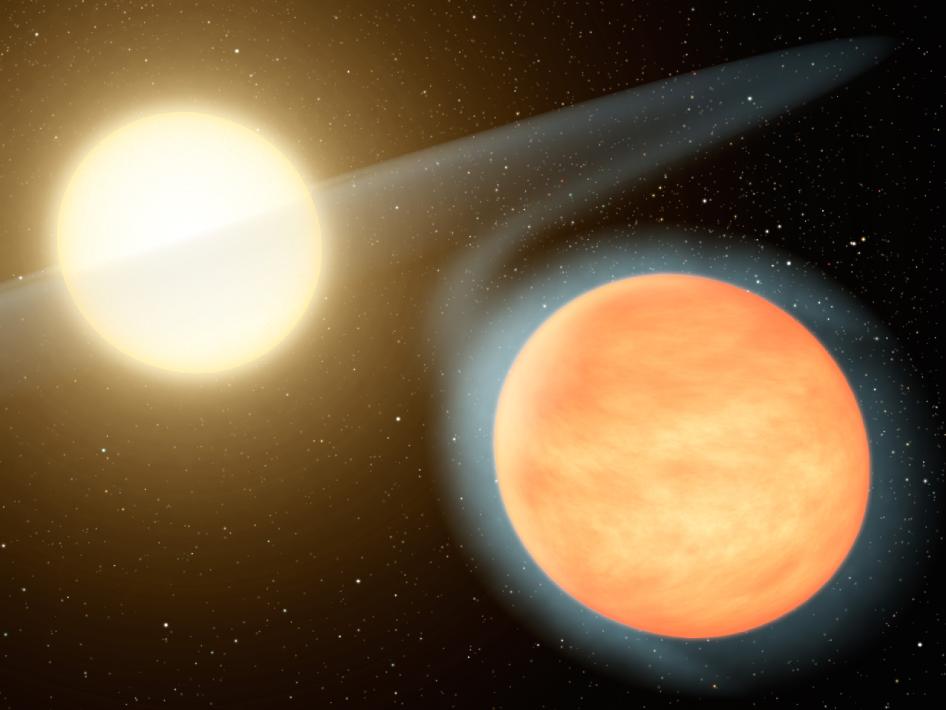
Astronomers have discovered that a huge, searing-hot planet orbiting another star is loaded with an unusual amount of carbon. The planet, a gas giant named WASP-12b, is the first carbon-rich world ever observed. The discovery was made using NASA's Spitzer Space Telescope, along with previously published ground-based observations.

"This planet reveals the astounding diversity of worlds out there," said Nikku Madhusudhan of the Massachusetts Institute of Technology, Cambridge, lead author of a report in the Dec. 9 issue of the journal Nature. "Carbon-rich planets would be exotic in every way -- formation, interiors and atmospheres."

It's possible that WASP-12b might harbor graphite, diamond, or even a more exotic form of carbon in its interior, beneath its gaseous layers. Astronomers don't currently have the technology to observe the cores of exoplanets, or planets orbiting stars beyond our sun, but their theories hint at these intriguing possibilities.


Wednesday, December 08, 2010

SpaceX Falcon 9

The first SpaceX Falcon 9 demonstration launch for NASA's Commercial Orbital Transportation Services program is scheduled for Wednesday, Dec. 8, from Launch Complex 40 at Cape Canaveral Air Force Station in Florida. The launch window extends from 9 a.m. to 12:22 p.m. EST.

Monday, December 06, 2010

NASA Aids in Characterizing Super-Earth


A team of astronomers, including two NASA Sagan Fellows, has made the first characterizations of a super-Earth's atmosphere, by using a ground-based telescope. A super-Earth is a planet up to three times the size of Earth and weighing up to 10 times as much. The findings, reported in the Dec. 2 issue of the journal Nature, are a significant milestone toward eventually being able to probe the atmospheres of Earth-like planets for signs of life.

The team determined the planet, GJ 1214b, is either blanketed with a thin layer of water steam or surrounded by a thick layer of high clouds. If the former, the planet itself would have an icy composition. If the latter, the planet would be rocky or similar to the composition of Neptune, though much smaller.

"This is the first super-Earth known to have an atmosphere," said Jacob Bean, a NASA Sagan Fellow and astronomer at the Harvard-Smithsonian Center for Astrophysics in Cambridge, Mass. "But even with these new measurements, we can't say yet what that atmosphere is made of. This world is being very shy and veiling its true nature from us."

GJ 1214b, first discovered in December 2009, is 2.7 times the size of Earth and 6.5 times as massive. Previous observations of the planet's size and mass demonstrated it has a low density for its size, leading astronomers to conclude the planet is some kind of solid body with an atmosphere.

The planet orbits close to its dim star, at a distance of 0.014 astronomical units. An astronomical unit is the distance between Earth and the sun, approximately 93 million miles. GJ 1214b circles too close to its star to be habitable by any life forms.

Bean and his team observed infrared light as the planet crossed in front of its star. During such transits, the star's light filters through the atmosphere. Gases absorb the starlight at particular wavelengths, leaving behind chemical fingerprints detectable from Earth. This same type of technique has been used to study the atmospheres of distant "hot Jupiters," or Jupiter-like planets orbiting close to their stars, and found gases like hydrogen, methane and sodium vapor.

In the case of the super-Earth, no chemical fingerprints were detected; however, this doesn't mean there are no chemicals present. Instead, this information ruled out some possibilities for GJ 1214b's atmosphere, and narrowed the scope to either an atmosphere of water steam or high clouds. Astronomers believe it's more likely the atmosphere is too thin around the planet to let enough light filter through and reveal chemical fingerprints.

"A steamy atmosphere would have to be very dense – about one-fifth water vapor by volume -- compared to our Earth, with an atmosphere that's four-fifths nitrogen and one-fifth oxygen with only a touch of water vapor," Bean said. "During the next year, we should have some solid answers about what this planet is truly like."

The team, which included Bean's co-authors -- Eliza Miller-Ricci Kempton, a NASA Sagan Fellow at the University of California in Santa Cruz, and Derek Homeier of the Institute for Astrophysics in Gottingen, Germany -- examined GJ 1214b using the ground-based Very Large Telescope at Paranal Observatory in Chile.

"This is an important step forward, narrowing our understanding of the atmosphere of this planet," said NASA Exoplanet Exploration Program Scientist Douglas Hudgins at NASA Headquarters in Washington. "Bizarre worlds like this make exoplanet science one of the most compelling areas in astrophysics today."

The Sagan Fellowship Program is administered by the NASA Exoplanet Science Institute at the California Institute of Technology in Pasadena. Its purpose is to advance the scientific and technical goals of NASA's Exoplanet Exploration Program. The program is managed for NASA by the Jet Propulsion Laboratory in Pasadena, Calif. Caltech manages JPL for NASA.

More information about NASA's planet-finding missions is online at:http://planetquest.jpl.nasa.gov . More information about NASA's Sagan Fellowship Program is at http://nexsci.caltech.edu/sagan .

Saturday, December 04, 2010

Cassini Returns Images of Bright Jets at Enceladus


NASA's Cassini spacecraft successfully dipped near the surface of Saturn's moon Enceladus on Nov. 30. Though Cassini's closest approach took it to within about 48 kilometers (30 miles) of the moon's northern hemisphere, the spacecraft also captured shadowy images of the tortured south polar terrain and the brilliant jets that spray out from it.

Many of the raw images feature darkened terrain because winter has descended upon the southern hemisphere of Enceladus. But sunlight behind the moon backlights the jets of water vapor and icy particles. In some images, the jets line up in rows, forming curtains of spray.

The new raw images can be seen at http://saturn.jpl.nasa.gov/photos/raw/ .

The Enceladus flyby was the 12th of Cassini's mission, with the spacecraft swooping down around 61 degrees north latitude. This encounter and its twin three weeks later at the same altitude and latitude, are the closest Cassini will come to the northern hemisphere surface of Enceladus during the extended Solstice mission. (Cassini's closest-ever approach to Enceladus occurred in October 2008, when the spacecraft dipped to an altitude of 25 kilometers, or 16 miles.)

Among the observations Cassini made during this Enceladus flyby, the radio science subsystem collected gravity measurements to understand the moon's interior structure, and the fields and particles instruments sampled the charged particle environment around the moon.

About two days before the Enceladus flyby, Cassini also passed the sponge-like moon Hyperion, beaming back intriguing images of the craters on its surface. The flyby, at 72,000 kilometers (45,000 miles) in altitude, was one of the closest approaches to Hyperion that Cassini has made.

Scientists are still working to analyze the data and images collected during the flybys.

The Cassini-Huygens mission is a cooperative project of NASA, the European Space Agency and the Italian Space Agency. The Jet Propulsion Laboratory manages the project for NASA's Science Mission Directorate in Washington. The Cassini orbiter was designed, developed and assembled at JPL. The imaging operations center is based at the Space Science Institute in Boulder, Colo.

More Cassini information is available, at t http://www.nasa.gov/cassini and http://saturn.jpl.nasa.gov .

Tuesday, November 30, 2010

Thin Air - Cassini Finds Ethereal Atmosphere at Rhea


NASA's Cassini spacecraft has detected a very tenuous atmosphere known as an exosphere, infused with oxygen and carbon dioxide around Saturn's icy moon Rhea. This is the first time a spacecraft has directly captured molecules of an oxygen atmosphere – albeit a very thin one -- at a world other than Earth.

The oxygen appears to arise when Saturn's magnetic field rotates over Rhea. Energetic particles trapped in the planet's magnetic field pepper the moon’s water-ice surface. They cause chemical reactions that decompose the surface and release oxygen. The source of the carbon dioxide is less certain.

Oxygen at Rhea's surface is estimated to be about 5 trillion times less dense than what we have at Earth. But the new results show that surface decomposition could contribute abundant molecules of oxygen, leading to surface densities roughly 100 times greater than the exospheres of either Earth's moon or Mercury. The formation of oxygen and carbon dioxide could possibly drive complex chemistry on the surfaces of many icy bodies in the universe.

"The new results suggest that active, complex chemistry involving oxygen may be quite common throughout the solar system and even our universe," said lead author Ben Teolis, a Cassini team scientist based at Southwest Research Institute in San Antonio. "Such chemistry could be a prerequisite for life. All evidence from Cassini indicates that Rhea is too cold and devoid of the liquid water necessary for life as we know it."

Releasing oxygen through surface irradiation could help generate conditions favorable for life at an icy body other than Rhea that has liquid water under the surface, Teolis said. If the oxygen and carbon dioxide from the surface could somehow get transported down to a sub-surface ocean, that would provide a much more hospitable environment for more complex compounds and life to form. Scientists are keen to investigate whether life on icy moons with an ocean is possible, though they have not yet detected it.

The tenuous atmosphere with oxygen and carbon dioxide makes Rhea, Saturn's second largest moon, unique in the Saturnian system. Titan has a thick nitrogen-methane atmosphere, but very little carbon dioxide and oxygen.

"Rhea is turning out to be much more interesting than we had imagined," said Linda Spilker, Cassini project scientist at NASA's Jet Propulsion Laboratory, Pasadena, Calif. "The Cassini finding highlights the rich diversity of Saturn’s moons and gives us clues on how they formed and evolved."

Scientists had suspected Rhea could have a thin atmosphere with oxygen and carbon dioxide, based on remote observations of Jupiter's icy moons by NASA's Galileo spacecraft and Hubble Space Telescope. Other Cassini observations detected oxygen escaping from icy Saturn ring particles after ultraviolet bombardment. But Cassini was able to detect oxygen and carbon dioxide in the exosphere directly because of how close it flew to Rhea – 101 kilometers, or 63 miles – and its special suite of instruments.

In the new study, scientists combined data from Cassini's ion and neutral mass spectrometer and the Cassini plasma spectrometer during flybys on Nov. 26, 2005, Aug. 30, 2007, and March 2, 2010. The ion and neutral mass spectrometer "tasted" peak densities of oxygen of around 50 billion molecules per cubic meter (1 billion molecules per cubic foot). It detected peak densities of carbon dioxide of around 20 billion molecules per cubic meter (about 600 million molecules per cubic foot).

The plasma spectrometer saw clear signatures of flowing streams of positive and negative ions, with masses that corresponded to ions of oxygen and carbon dioxide.

"How exactly the carbon dioxide is released is still a puzzle," said co-author Geraint Jones, a Cassini team scientist based at University College London in the U.K. "But with Cassini's diverse suite of instruments observing Rhea from afar, as well as sniffing the gas surrounding it, we hope to solve the puzzle."

The carbon dioxide may be the result of “dry ice” trapped from the primordial solar nebula, as is the case with comets, or it may be due to similar irradiation processes operating on the organic molecules trapped in the water ice of Rhea. The carbon dioxide could also come from carbon-rich materials deposited by tiny meteors that bombarded Rhea's surface.

The Cassini-Huygens mission is a cooperative project of NASA, the European Space Agency, and the Italian Space Agency. NASA's Jet Propulsion Laboratory, Pasadena, Calif., a division of the California Institute of Technology in Pasadena, manages the mission for NASA's Science Mission Directorate, Washington, D.C. The Cassini orbiter was designed, developed and assembled at JPL. The ion and neutral mass spectrometer team and the Cassini plasma spectrometer team are based at Southwest Research Institute, San Antonio.

For more information about the Cassini mission, visit: http://www.nasa.gov/cassini and http://saturn.jpl.nasa.gov .

Friday, November 26, 2010

Stripes Are Back in Season on Jupiter


New NASA images support findings that one of Jupiter's stripes that "disappeared" last spring is now showing signs of a comeback. These new observations will help scientists better understand the interaction between Jupiter's winds and cloud chemistry.

Earlier this year, amateur astronomers noticed that a longstanding dark-brown stripe, known as the South Equatorial Belt, just south of Jupiter's equator, had turned white. In early November, amateur astronomer Christopher Go of Cebu City, Philippines, saw an unusually bright spot in the white area that was once the dark stripe. This phenomenon piqued the interest of scientists at NASA's Jet Propulsion Laboratory, Pasadena, Calif., and elsewhere.

After follow-up observations in Hawaii with NASA's Infrared Telescope Facility, the W.M. Keck Observatory and the Gemini Observatory telescope, scientists now believe the vanished dark stripe is making a comeback.

First-glimpse images of the re-appearing stripe are online at: http://www.nasa.gov/topics/solarsystem/features/jupiter20101124-i.html.

"The reason Jupiter seemed to 'lose' this band - camouflaging itself among the surrounding white bands - is that the usual downwelling winds that are dry and keep the region clear of clouds died down," said Glenn Orton, a research scientist at JPL. "One of the things we were looking for in the infrared was evidence that the darker material emerging to the west of the bright spot was actually the start of clearing in the cloud deck, and that is precisely what we saw."

This white cloud deck is made up of white ammonia ice. When the white clouds float at a higher altitude, they obscure the missing brown material, which floats at a lower altitude. Every few decades or so, the South Equatorial Belt turns completely white for perhaps one to three years, an event that has puzzled scientists for decades. This extreme change in appearance has only been seen with the South Equatorial Belt, making it unique to Jupiter and the entire solar system.

The white band wasn't the only change on the big, gaseous planet. At the same time, Jupiter's Great Red Spot became a darker red color. Orton said the color of the spot - a giant storm on Jupiter that is three times the size of Earth and a century or more old - will likely brighten a bit again as the South Equatorial Belt makes its comeback.

The South Equatorial Belt underwent a slight brightening, known as a "fade," just as NASA's New Horizons spacecraft was flying by on its way to Pluto in 2007. Then there was a rapid "revival" of its usual dark color three to four months later. The last full fade and revival was a double-header event, starting with a fade in 1989, revival in 1990, then another fade and revival in 1993. Similar fades and revivals have been captured visually and photographically back to the early 20th century, and they are likely to be a long-term phenomenon in Jupiter's atmosphere.

Scientists are particularly interested in observing this latest event because it's the first time they've been able to use modern instruments to determine the details of the chemical and dynamical changes of this phenomenon. Observing this event carefully may help to refine the scientific questions to be posed by NASA's Juno spacecraft, due to arrive at Jupiter in 2016, and a larger, proposed mission to orbit Jupiter and explore its satellite Europa after 2020.

The event also signifies another close collaboration between professional and amateur astronomers. The amateurs, located worldwide, are often well equipped with instrumentation and are able to track the rapid developments of planets in the solar system. These amateurs are collaborating with professionals to pursue further studies of the changes that are of great value to scientists and researchers everywhere.

"I was fortunate to catch the outburst," said Christopher Go, referring to the first signs that the band was coming back. "I had a meeting that evening and it went late. I caught the outburst just in time as it was rising. Had I imaged earlier, I would not have caught it," he said. Go, who also conducts in the physics department at the University of San Carlos, Cebu City, Philippines, witnessed the disappearance of the stripe earlier this year, and in 2007 he was the first to catch the stripe's return. "I was able to catch it early this time around because I knew exactly what to look for."

NASA's Exoplanet Science Institute at the California Institute of Technology in Pasadena manages time allocation on the Keck telescope for NASA. Caltech manages JPL for NASA.

For more information about NASA and agency programs, visit: http://www.nasa.gov/home.

Tuesday, November 23, 2010

Tuning an 'Ear' to the Music of Gravitational Waves


A team of scientists and engineers at NASA's Jet Propulsion Laboratory has brought the world one step closer to "hearing" gravitational waves -- ripples in space and time predicted by Albert Einstein in the early 20th century.

The research, performed in a lab at JPL in Pasadena, Calif., tested a system of lasers that would fly aboard the proposed space mission called Laser Interferometer Space Antenna, or LISA. The mission's goal is to detect the subtle, whisper-like signals of gravitational waves, which have yet to be directly observed. This is no easy task, and many challenges lie ahead.

The new JPL tests hit one significant milestone, demonstrating for the first time that noise, or random fluctuations, in LISA's laser beams can be hushed enough to hear the sweet sounds of the elusive waves.

"In order to detect gravitational waves, we have to make extremely precise measurements," said Bill Klipstein, a physicist at JPL. "Our lasers are much noisier than what we want to measure, so we have to remove that noise carefully to get a clear signal; it's a little like listening for a feather to drop in the middle of a heavy rainstorm." Klipstein is a co-author of a paper about the lab tests that appeared in a recent issue of Physical Review Letters.

The JPL team is one of many groups working on LISA, a joint European Space Agency and NASA mission proposal, which, if selected, would launch in 2020 or later. In August of this year, LISA was given a high recommendation by the 2010 U.S. National Research Council decadal report on astronomy and astrophysics.

One of LISA's primary goals is to detect gravitational waves directly. Studies of these cosmic waves began in earnest decades ago when, in 1974, researchers discovered a pair of orbiting dead stars -- a type called pulsars -- that were spiraling closer and closer together due to an unexplainable loss of energy. That energy was later shown to be in the form of gravitational waves. This was the first indirect proof of the waves, and ultimately earned the 1993 Nobel Prize in Physics.

LISA is expected to not only "hear" the waves, but also learn more about their sources -- massive objects such as black holes and dead stars, which sing the waves like melodies out to the universe as the objects accelerate through space and time. The mission would be able to detect gravitational waves from massive objects in our Milky Way galaxy as well as distant galaxies, allowing scientists to tune into an entirely new language of our universe.

The proposed mission would amount to a giant triangle of three distinct spacecraft, each connected by laser beams. These spacecraft would fly in formation around the sun, about 20 degrees behind Earth. Each one would hold a cube made of platinum and gold that floats freely in space. As gravitational waves pass by the spacecraft, they would cause the distance between the cubes, or test masses, to change by almost imperceptible amounts -- but enough for LISA's extremely sensitive instruments to be able to detect corresponding changes in the connecting laser beams.

"The gravitational waves will cause the 'corks' to bob around, but just by a tiny bit," said Glenn de Vine, a research scientist and co-author of the recent study at JPL. "My friend once said it's sort of like rubber duckies bouncing around in a bathtub."

The JPL team has spent the last six years working on aspects of this LISA technology, including instruments called phase meters, which are sophisticated laser beam detectors. The latest research accomplishes one of their main goals -- to reduce the laser noise detected by the phase meters by one billion times, or enough to detect the signal of gravitational waves.

The job is like trying to find a proton in a haystack. Gravitational waves would change the distance between two spacecraft -- which are flying at 5 million kilometers (3.1 million miles) apart -- by about a picometer, which is about 100 million times smaller than the width of a human hair. In other words, the spacecraft are 5,000,000,000 meters apart, and LISA would detect changes in that distance on the order of .000000000005 meters!

At the heart of the LISA laser technology is a process known as interferometry, which ultimately reveals if the distances traveled by the laser beams of light, and thus the distance between the three spacecraft, have changed due to gravitational waves. The process is like combining ocean waves -- sometimes they pile up and grow bigger, and sometimes they cancel each other out or diminish in size.

"We can't use a tape measure to get the distances between these spacecraft," said de Vine, "So we use lasers. The wavelengths of the lasers are like our tick marks on a tape measure."

On LISA, the laser light is detected by the phase meters and then sent to the ground, where it is "interfered" via data processing (the process is called time-delay interferometry for this reason -- there's a delay before the interferometry technique is applied). If the interference pattern between the laser beams is the same, then that means the spacecraft haven't moved relative to each other. If the interference pattern changes, then they did. If all other reasons for spacecraft movement have been eliminated, then gravitational waves are the culprit.

That's the basic idea. In reality, there are a host of other factors that make this process more complex. For one thing, the spacecraft don't stay put. They naturally move around for reasons that have nothing to do with gravitational waves. Another challenge is the laser beam noise. How do you know if the spacecraft moved because of gravitational waves, or if noise in the laser is just making it seem as if the spacecraft moved?

This is the question the JPL team recently took to their laboratory, which mimics the LISA system. They introduced random, artificial noise into their lasers and then, through a complicated set of data processing actions, subtracted most of it back out. Their recent success demonstrated that they could see changes in the distances between mock spacecraft on the order of a picometer.

In essence, they hushed the roar of the laser beams, so that LISA, if selected for construction, will be able to hear the universe softly hum a tune of gravitational waves.

Other authors of the paper from JPL are Brent Ware; Kirk McKenzie; Robert E. Spero and Daniel A. Shaddock, who has a joint post with JPL and the Australian National University in Canberra.

LISA is a proposed joint NASA and European Space Agency mission. The NASA portion of the mission is managed by NASA's Goddard Space Flight Center, Greenbelt, Md. Some of the key instrumentation studies for the mission are being performed at JPL. The U.S. mission scientist is Tom Prince at the California Institute of Technology in Pasadena. JPL is managed by Caltech for NASA.

Wednesday, November 17, 2010

How to See the Best Meteor Showers of the Year: Tools, Tips and 'Save the Dates'

There are several major meteor showers to enjoy every year at various times, with some more active than others. For example, April's Lyrids are expected to produce about 15 meteors an hour at their peak for observers viewing in good conditions. Now, if you put the same observer in the same good conditions during a higher-rate shower like August's Perseids or December's Geminids, that person could witness up to 80 meteors an hour during peak activity.

The 2010 Leonid meteor shower peaks the evening of Wednesday, Nov. 17. While the annual shower has been spectacular in the past, this year's half-full moon will obstruct viewing for most backyard astronomers.

If you're viewing in dark conditions, the best viewing time will be after midnight, in the hours just before dawn. At most, expect to see approximately 15 meteors per hour.

Whether you're watching from a downtown area or the dark countryside, here are some tips to help you enjoy these celestial shows of shooting stars. Those streaks of light are really caused by tiny specks of comet-stuff hitting Earth's atmosphere at very high speed and disintegrating in flashes of light.

First a word about the moon - it is not the meteor watcher's friend. Light reflecting off a bright moon can be just as detrimental to good meteor viewing as those bright lights of the big city. There is nothing you can do except howl at the moon, so you'll have to put up with it or wait until the next favorable shower. However, even though the 2010 Perseids and Geminids share the night sky with the moon, they are still expected to produce more visible meteor activity than other major showers that don't have an interfering moon.

The best thing you can do to maximize the number of meteors you'll see is to get as far away from urban light pollution as possible and find a location with a clear, unclouded view of the night sky. If you enjoy camping, try planning a trip that coincides with dates of one of the meteor showers listed below. Once you get to your viewing location, search for the darkest patch of sky you can find, as meteors can appear anywhere overhead. The meteors will always travel in a path away from the constellation for which the shower is named. This apparent point of origin is called the "radiant." For example, meteors during a Leonid meteor shower will appear to originate from the constellation Leo. (Note: the constellation only serves as a helpful guide in the night's sky. The constellation is not the actual source of the meteors. For an overview of what causes meteor showers click on Meteor Showers: Shooting for Shooting Stars)

Whether viewing from your front porch or a mountaintop, be sure to dress for success. This means clothing appropriate for cold overnight temperatures, which might include mittens or gloves, and blankets. This will enable you to settle in without having to abandon the meteor-watching because your fingers are starting to turn colors.

Next, bring something comfortable on which to sit or lie down. While Mother Nature can put on a magnificent celestial display, meteor showers rarely approach anything on the scale of a July 4th fireworks show. Plan to be patient and watch for at least half an hour. A reclining chair or ground pad will make it far more comfortable to keep your gaze on the night sky.

Lastly, put away the telescope or binoculars. Using either reduces the amount of sky you can see at one time, lowering the odds that you'll see anything but darkness. Instead, let your eyes hang loose and don't look in any one specific spot. Relaxed eyes will quickly zone in on any movement up above, and you'll be able to spot more meteors. Avoid looking at your cell phone or any other light. Both destroy night vision. If you have to look at something on Earth, use a red light. Some flashlights have handy interchangeable filters. If you don't have one of those, you can always paint the clear filter with red fingernail polish.

The meteor showers listed below will provide casual meteor observers with the most bang for their buck. They are the easiest to observe and most active. All these showers are best enjoyed in the hours after midnight. Be sure to also check the "Related Links" box for additional information, and for tools to help you determine how many meteors may be visible from your part of the world.

Tuesday, November 16, 2010

Rocks and Stars with Amy: This Asteroid Inspected by #32

Over the course of the nine months we’ve been operating WISE, we’ve observed over 150,000 asteroids and comets of all different types. We had to pick all of these moving objects out of the hundreds of millions of sources observed all over the sky — so you can imagine that sifting through all those stars and galaxies to find the asteroids is not easy!

We use a lot of techniques to figure out how to distinguish an asteroid from a star or galaxy. Even though just about everything in the universe moves, asteroids are a whole lot closer to us than your average star (and certainly your average galaxy), so they appear to move from place to place in the WISE images over a timescale of minutes, unlike the much more distant stars. It’s almost like watching a pack of cyclists go by in the Tour de France. Also, WISE takes infrared images, which means that cooler objects like asteroids look different than the hotter stars. If you look at the picture below, you can see that the stars appear bright blue, whereas the sole asteroid in the frame appears red. That’s because the asteroid is about room temperature and is therefore much colder than the stars, which are thousands of degrees. Cooler objects will give off more of their light at longer, infrared wavelengths that our WISE telescope sees. We can use both of these unique properties of asteroids — their motion and their bright infrared signatures — to tease them out of the bazillions of stars and galaxies in the WISE images.


Thanks to the efforts of some smart scientists and software engineers, we have a very slick program that automatically searches the images for anything that moves at the longer, infrared wavelengths. With WISE, we take about a dozen or so images of each part of the sky over a couple of days. The system works by throwing out everything that appears again and again in each exposure. What’s left are just the so-called transient sources, the things that don’t stay the same between snapshots. Most of these are cosmic rays — charged particles zooming through space that are either spat out by our sun or burped up from other high-energy processes like supernovae or stars falling into black holes. These cosmic rays hit our detectors, leaving a blip that appears for just a single exposure. Also, really bright objects can leave an after-image on the detectors that can persist for many minutes, just like when you stare at a light bulb and then close your eyes. We have to weed the real asteroid detections out from the cosmic rays and after-images.

The data pipeline is smart enough to catch most of these artifacts and figure out what the real moving objects are. However, if it’s a new asteroid that no one has ever seen before, we have to have a human inspect the set of images and make sure that it’s not just a collection of artifacts that happened to show up at the right place and right time. About 20 percent of the asteroids that we observe appear to be new, and we examine those using a program that we call our quality assurance (QA) system, which lets us rapidly sift through hundreds of candidate asteroids to make sure they’re real. The QA system pops up a set of images of the candidate asteroid, along with a bunch of “before” and “after” images of the same part of the sky. This lets us eliminate any stars that might have been confused for the asteroids. Finally, since the WISE camera takes a picture every 11 seconds, we take a look at the exposures taken immediately before the ones with the candidate asteroid — if the source is really just an after-image persisting after we’ve looked at something bright, it will be there in the previous frame. We’ve had many students — three college students and two very talented high school students — work on asteroid QA. They’ve become real pros at inspecting asteroid candidates!


Meanwhile, the hunt continues — we’re still trekking along through the sky with the two shortest-wavelength infrared bands, now that we’ve run out of the super-cold hydrogen that was keeping two of the four detectors operating. Even though our sensitivity is lower, we’re still observing asteroids and looking for interesting things like nearby brown dwarfs (stars too cold to shine in visible light because they can’t sustain nuclear fusion). Our dedicated team of asteroid inspectors keeps plugging away, keeping the quality of the detections very high so that we leave the best possible legacy when our little telescope’s journey is finally done.

Thursday, November 11, 2010

Shedding 'Bent' Light on Dark Matter


Astronomers using NASA's Hubble Space Telescope took advantage of a giant cosmic magnifying glass to create one of the sharpest and most detailed maps of dark matter in the universe. Dark matter is an invisible and unknown substance that makes up the bulk of the universe's mass. Astronomer Dan Coe led the research while working at NASA's Jet Propulsion Laboratory in Pasadena, Calif.; he is currently with the Space Telescope Science Institute in Baltimore, Md.

The astronomers used Hubble to chart the invisible matter in the massive galaxy cluster Abell 1689, located 2.2 billion light-years away. The cluster's gravity, the majority of which comes from dark matter, acts like a cosmic magnifying glass, bending and amplifying the light from distant galaxies behind it. This effect, called gravitational lensing, produces multiple, warped, and greatly magnified images of those galaxies, like the view in a funhouse mirror. By studying the distorted images, astronomers estimated the amount of dark matter within the cluster.

The new dark matter observations may yield new insights into the role of dark energy in the universe's early formative years. A mysterious property of space, dark energy fights against the gravitational pull of dark matter. The new results suggest that galaxy clusters may have formed earlier than expected, before the push of dark energy inhibited their growth. Dark energy pushes galaxies apart from one another by stretching the space between them, suppressing the formation of giant structures called galaxy clusters. One way astronomers can probe this primeval tug-of-war is by mapping the distribution of dark matter in clusters.

Read the full story at http://hubblesite.org/newscenter/archive/releases/2010/37/full/ .

The California Institute of Technology in Pasadena manages JPL for NASA.

Tuesday, November 09, 2010

Reflecting Merope


In the well known Pleiades star cluster, starlight is slowly destroying this wandering cloud of gas and dust. The star Merope lies just off the upper left edge of this picture from the Hubble Space Telescope. In the past 100,000 years, part of the cloud has by chance moved so close to this star--only 3,500 times the Earth-Sun distance--that the starlight itself is having a very dramatic effect. Pressure of the star's light significantly repels the dust in the reflection nebula, and smaller dust particles are repelled more strongly. As a result, parts of the dust cloud have become stratified, pointing toward Merope. The closest particles are the most massive and the least affected by the radiation pressure. A longer-term result will be the general destruction of the dust by the energetic starlight.